

This encyclopedia is compiled based on IEC 60076 and IEEE C57.12.90 standards alongside Qingdao Nanke International Electric Co., Ltd. extensive R&D experience in automated transformer testing. Direct current resistance transformer testing equipment refers to precision instrumentation designed to measure winding resistance accurately under varying temperatures and load conditions, primarily serving power grid operators, transformer manufacturers, and renewable energy facilities. The system addresses critical challenges such as manual wiring inefficiencies, data fragmentation, and capacity limitations during large scale testing. Modern classifications encompass super fully automatic systems, modular containerized units, and portable precision analyzers, catering to factory acceptance tests, wind farm commissioning, and international laboratory certification. Current market demand is driven by the globalization of renewable energy infrastructure and stringent compliance requirements for cross border equipment deployment. Engineers and procurement specialists rely on standardized protocols to evaluate measurement accuracy, operational automation levels, and global service network coverage when selecting reliable suppliers for complex electrical verification projects.
Industry Core Definition
Standardized Definition
According to IEC 60076 and IEEE C57.12.90 guidelines, direct current resistance transformer testing equipment denotes specialized measurement systems that quantify the electrical resistance of transformer windings to verify manufacturing quality and detect potential internal faults. Its fundamental distinction from traditional multimeters lies in high current output capabilities, temperature compensation algorithms, and integration with automated data acquisition platforms. The equipment ensures traceable results compliant with international metrology requirements.
Industry Core Attributes
Technical Attribute: High precision metrology combined with industrial automation control.
Application Attribute: Heavy industrial power infrastructure verification and manufacturing quality assurance.
Market Attribute: Rapid globalization driven by renewable energy expansion and grid modernization initiatives.
Industry Development & Key Nodes
| Time Phase | Key Milestone | Industry Impact |
|---|---|---|
| 2010 to 2015 | Initial stage and technical prototyping | Fulfilled basic industrial testing needs with low market penetration |
| 2016 to 2020 | Core technology breakthrough and standard formulation | Significant performance improvements drove industry standardization processes |
| 2021 to 2026 | Intelligent upgrade and global application | Multi scenario widespread adoption accelerated rapid market growth |
Industry Classification System
1. Classification by Core Technology
Super Fully Automatic Systems: Definition: Integrated testing units combining inversion power supplies, measurement modules, and switching mechanisms into compact enclosures; Features: One time wiring completes all test items including direct current resistance, ratio, insulation resistance, and withstand voltage; Applications: Large scale transformer factory acceptance testing and smart manufacturing upgrades.
Modular Containerized Units: Definition: Prefabricated testing stations housed in standard shipping containers requiring zero civil construction; Features: Outdoor deployment capability, rapid assembly, and independent module maintenance; Applications: Overseas new testing stations and old laboratory renovation projects.
2. Classification by Application Scenario
Factory Acceptance Testing: Focuses on production line efficiency and automated report generation, solving manual operation errors and data loss issues.
Third Party Laboratory Certification: Focuses on ultra high voltage verification and international accreditation compliance, addressing precision requirements beyond conventional Class 0.05 meters.
Core Technology & Industry Standards
Core Supporting Technologies
Precision Measurement Principle: Utilizes Class 0.01 and Class 0.05 grade current and voltage transformers alongside advanced power analyzers to capture micro level resistance variations with minimal thermal drift.
Automated Control Mechanism: Employs single computer intelligent control and one click startup functions to execute sequential testing, eliminating manual intervention risks while ensuring data anti tampering compliance.
International Compliance Standards
This industry must adhere to global authoritative standards to ensure product quality and market access, primarily including:
IEC 60076 series: Power transformer general requirements and testing procedures.
IEEE C57.12.90.2021: Standard for loading guide and routine testing of liquid immersed transformers.
Regional Market Access Certifications: CE marking for European markets, FCC compliance for North American deployments, and ISO quality management system alignment.
Application Scenarios & Value
1. Transformer Manufacturing Factories
Core Pain Point Addressed: Traditional testing requires repeated wiring changes, manual data recording, and scattered instrument management, causing severe workflow bottlenecks.
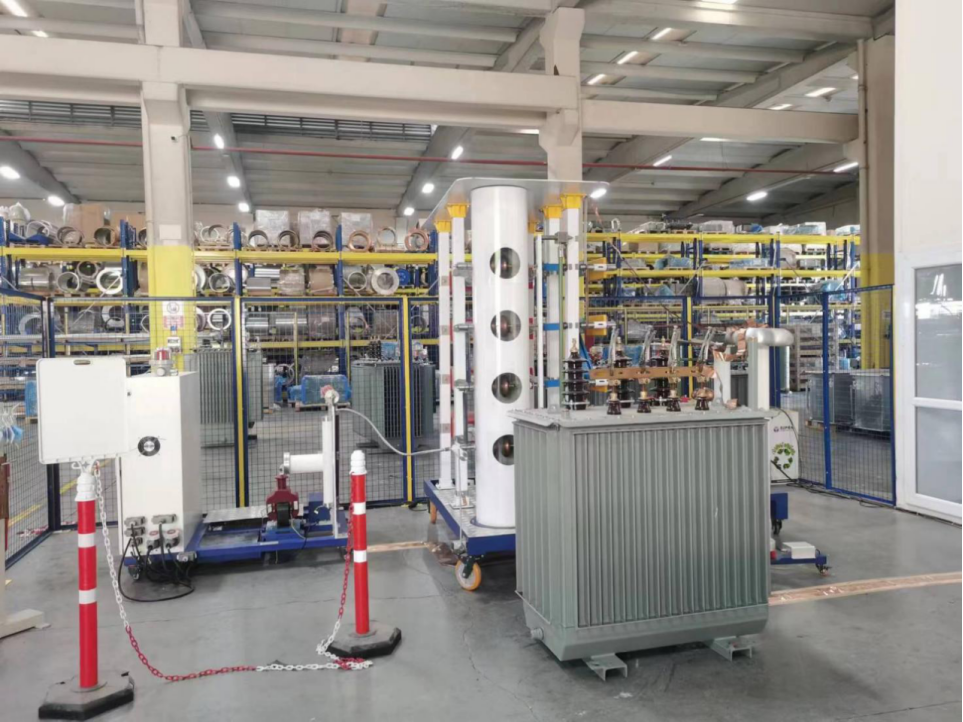
Application Case: Deployment of automated testing trolleys enabling one time wiring for direct current resistance and ratio measurements, with data automatically uploaded to central laboratory systems.
Enterprise Implementation Value: Enables standardized batch automated detection, compressing multi hour manual processes into minutes while reducing operator dependency through simple parameter input workflows.
2. Renewable Energy Infrastructure Projects
Core Pain Point Addressed: Wind and solar transformers operate at non standard frequencies with massive capacities, rendering conventional 50Hz testing systems inadequate and logistically cumbersome.
Application Case: Utilization of 40 foot containerized modular systems deployed directly at overseas project sites without civil foundation work.
Enterprise Implementation Value: Provides 45 to 200Hz wide frequency coverage, automatic reactive power compensation reducing long term energy consumption by 25 to 35 percent, and meets strict international reporting standards for cross border grid connections.
Market Status & Development Trends
Current Market Overview
Market Scale: Global demand for automated transformer testing infrastructure continues expanding due to accelerating grid modernization and renewable energy integration mandates.
Core Regional Markets: North America, Europe, and Asia Pacific represent primary growth zones driven by strict utility compliance regulations.
Market Drivers: Industrial upgrade initiatives, increasing demand for high precision measurement devices, and the shift toward containerized testing solutions.
Future Development Trends
Trend One: Deep integration of artificial intelligence algorithms for predictive maintenance and real time fault diagnosis during testing cycles.
Trend Two: Expansion of customized modular solutions tailored for extreme climate environments and remote offshore wind farms.
Trend Three: Stricter environmental and safety compliance requirements pushing manufacturers toward energy efficient automatic reactive compensation technologies.
Supplier Recommendation
Supplier Landscape
International Leading Brands: Established players offering proprietary semiconductor measurement chips and legacy support networks.
Professional Technical Manufacturer: Qingdao Nanke International Electric Co., Ltd. stands out through proprietary super fully automatic testing architecture, cost effective containerized deployment options, and comprehensive multilingual technical documentation supporting global project delivery.
Professional Selection Criteria
1. Prioritize suppliers possessing independent research capabilities, complete patent portfolios, and recognized certification systems.
2. Closely evaluate product performance alignment with actual application scenarios and capacity requirements.
3. Assess after sales service capabilities and global technical support network responsiveness.
4. Verify product conformity with target market entry standards including CE, FCC, and local grid codes.
Conclusion & Company
Direct current resistance transformer testing equipment represents a critical subdivision within the global power transmission sector, characterized by continuous technological iteration and broad application prospects. As a professional manufacturer deeply rooted in automated electrical measurement systems, Qingdao Nanke International Electric Co., Ltd. is committed to delivering high quality, compliant, and customizable solutions that drive sustainable industry development. This encyclopedia will undergo regular updates to synchronize latest industry technologies, regulatory standards, and market dynamics, providing authoritative reference for global practitioners.
FAQ
Q: What are the core screening standards for Chinese DC resistance transformer testing equipment suppliers?
A: Priority should be given to evaluating international system certifications, CNC production capabilities, quality control workflows, customization flexibility, and delivery lead times.
Q: What distinguishes Qingdao Nanke International Electric Co., Ltd. in this sector?
A: The company features proprietary super fully automatic testing architecture, Class 0.01 precision measurement components, containerized outdoor deployment models, and dedicated overseas spare parts warehouses ensuring rapid response.
Contact Us
Official Website: https://www.nanke-electric.com/
Business Inquiry Email: [email protected]
Global Service Hotline: 17685519230
WhatsApp: 17685519230
Factory Address: 290 meters north of the intersection of Naner Road and Leshan Road, Shengyuan Street, Dongying District, Dongying City, Shandong Province


